
Pillar 1
Basic & Special Education
To build on the NUGS Basic School Infrastructure and Support Projects, accelerating real, measurable progress against Ghana's schools-under-trees crisis and strengthening NUGS's role as a national advocate and partner for inclusive basic and special education.
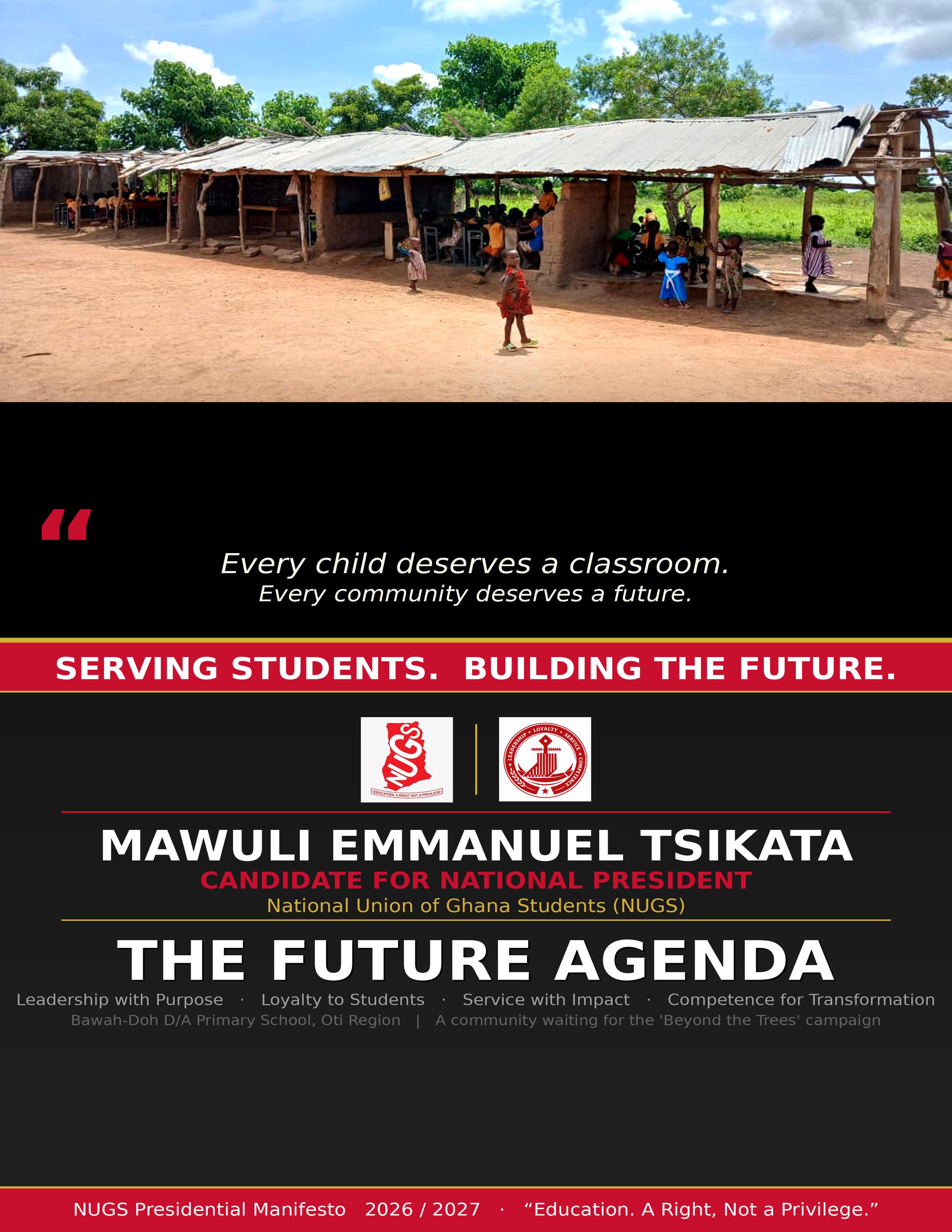
Current challenges & evidence
- Over 5,400 schools in Ghana still operate under trees or in unsafe, makeshift structures, concentrated in the Northern, Savannah, North East, Oti and Western North regions.
- Learning materials, furniture and sanitation facilities are unevenly distributed, with deprived districts consistently at the back of the queue.
- Special-needs learners are frequently absent from district planning and budgeting, with few trained staff and almost no assistive learning materials.
Proposed solutions
- Launch Project Foundations, a targeted learning-materials and furniture support programme for deprived basic schools in the five priority regions.
- Partner with GES, GETFund, district assemblies and CSOs such as Africa Education Watch to publish an evidence-based schools-under-trees advocacy record.
- Establish a special education advocacy desk pressing for trained staff, assistive materials and explicit district-level budget lines.
- Feed every school reached into the Manifesto Tracker so the numbers can be independently verified.
Expected outcomes
Project Foundations operational with published criteria; documented learning-materials support reaching additional deprived basic schools; a public advocacy record on schools under trees.
Key performance indicators
Number of schools supported; regions covered; volume of materials and furniture delivered; number of special-education commitments secured from duty-bearers.
Timeline
Months 1 to 3: programme design and partner agreements. Months 4 to 9: first delivery cycles. Month 12: published review at Congress.